
The South Moravian Region is situated in the southeast of the Czech Republic, bordering on Austria and Slovakia. Its area of 7,188 km2 covers approximately 9 % of the Czech Republic's territory. The region is further divided into seven districts (Blansko, Brno-City, Brno-Country, Břeclav, Hodonín, Vyškov and Znojmo) and consists of 673 municipalities in total.
South Moravia is the innovation hub of the Czech Republic. This innovative journey began more than 20 years ago in 2002 when the JIC (South Moravian Innovation Centre) was established. The South Moravian Region has great economic potential. The number of businesses in computer technology, telecommunications, software development and other hi-tech fields is rising steadily, particularly in recent years. The South Moravian Region offers significant support to the development of technology and biotechnology incubators designed for new companies. It is a home to a number of research and innovation centers. The largest ones being: CEITEC (Central European Institute of Technology); CzechGlobe (Global Change Research Centre); FNUSA-ICRC (International Clinical Research Center); JIC (South Moravian Innovation Centre) and JINAG (South Moravian Agency for Public Innovation). The Region also hosts a large number of technologically oriented universities – the Masaryk University, the Mendel University in Brno and the Brno University of Technology in particular, fostering new generations of scientists and innovators.
Contact detail
-
Head of office
-
Contact person
-
Brussels Office Address
Rue Wiertz 31
1050 Brussels
Belgium

S3 Strategy
The Smart Specialization Strategy effectively targets funds (European, national, regional and private) towards activities that strengthen innovation capacity and towards the priority-marked areas of those specializations striving to increase the competitiveness of the Czech Republic. In the Czech context, the output from fulfilling these preliminary conditions has been the Regional Innovation Strategies, the regional dimensions of which are provided in the 14 regional appendices, focused on the specifics of forming a regional innovation strategy for the regions in question. One aspect of these regional appendices is to detail with greater precision the national priorities in relation to science and research, and the innovation potential of that particular region. The Regional Innovation Strategy of the South Moravian Region 2021-2027 (RIS SMR) is a fundamental strategic document of the South Moravian Region and the statutory city of Brno for implementing policy to support competitiveness, founded in particular on innovation and maximizing the economic benefits of public investment into research and education. The RIS SMR was established to create the conditions for competitive, knowledge-intensive business, through investment in raising standards in education and research, improving the image of the SMR and through direct support of entrepreneurial activities.
Strategic R&I Projects
STARGATE
The aim of STARGATE (reSilienT fARminG Adaptive microclimaTe managEment) is to create and implement a framework that will improve the resilience of farming to variable climatic conditions and extreme weather events and it will also help policymakers in landscape planning and long-term adaptation to climate change.
WEBSITE>
IWatermap
The aim is to improve innovation policies for ameliorating the critical mass development of innovation ecosystems in the water technology sector that could create the conditions for raising competitiveness, growth and jobs in the regions.
WEBSITE>
PlusChange (Horizon EU)
A new project called PLUS Change: Planning land use strategies to meet climate, biological and social goals in a changing world. Funded by Horizon Europe, the project will start on June 1st, 2023, and run for 4 years. It involves 23 partners from across the EU, UK and Switzerland, including research institutes, universities, SMEs, planning authorities and regional development agencies.
WEBSITE>BeReady (Interreg Danube)
Climate change is a threat to the whole world. It is essential to actively prepare for the impacts of these changes. That is why we are involved in the BeReady project (UrBan hEat islands REsilience, prepAreDness and mitigation strategY), which addresses climate change with regards to ecosystem approaches in the countries around the Danube, including the Czech Republic.
WEBSITE>GreenGov Project (Interreg Europe)
Climate commitment is an increasingly frequent topic in public administration. Environmental protection is beginning to emerge as one of the main conditions of EU-funded projects. However, navigating European legislation can sometimes be difficult and overwhelming for smaller local authorities. In early April 2024, the GreenGov project was launched to help regions understand the EU taxonomy and thus improve project funding in places that are floundering on sustainability.
WEBSITE>Network of energy managers in the South Moravian Region (LIFE)
South Moravian Region is the only Czech region building a network of energy managers through the international LIFE project, whose main mission is to transform the energy situation in the South Moravian Region. Our goal is to achieve a significant increase in energy efficiency and reduction of greenhouse gas emissions through the introduction of energy management in municipalities and in-depth reconstruction of public buildings. This is not only an ecological but also an economic step in the right direction.
WEBSITE>Climate Action Plan of the South Moravian Region (LIFE)
Life in the Czech Republic is changing as a result of climate change – and in the South Moravian Region more than elsewhere. The South Moravian Region has therefore decided to actively face this challenge and has been developing a Climate Action Plan for the period 2025 to 2050 since December 2023. JINAG has therefore been entrusted by the Council of the South Moravian Region with the preparation of this plan.
WEBSITE>ERRIN activities
Management Board members

Latest Tweets
Latest Tweets
Latest Updates
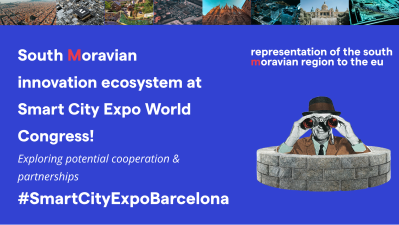
- By Intern SMR
Meet the South Moravian innovation ecosystem at Smart City Expo World Congress 2026
From 3–5 November 2026, Barcelona will host Smart City Expo World Congress, one of the leading international events focused on urban innovation. The South Moravian innovation ecosystem will be represented at the Czech national pavilion, bringing together organisations and stakeholders from the region. We are looking forward to meeting potential partners, exchanging experiences and exploring opportunities for future cooperation. If you are attending the event, we would be happy to arrange a meeting with you in Barcelona!
- By Martina Campajola
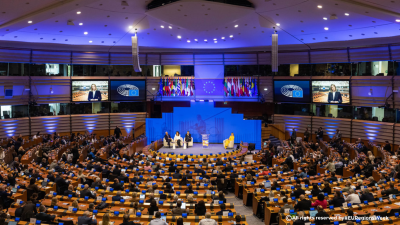
Strong regions, strong Europe: ERRIN at the European Week of Regions and Cities 2026
ERRIN spent the European Week of Regions and Cities moderating sessions, following debates and meeting more than a dozen member delegations. Here is a selection of the moments closest to our priorities, from the EU Missions and the next MFF to talent, culture and competitiveness.
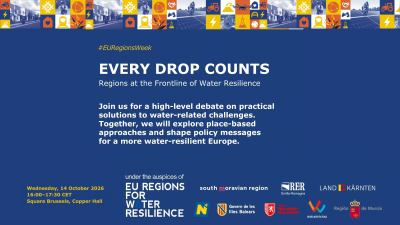
- By Intern SMR
EU Regions Week Session Every Drop Counts: Regions at the Frontline of Water Resilience
Join EU Regions Week Session called Every Drop Counts: Regions at the Frontline of Water Resilience. The session will explore how regions can lead Europe’s response to growing water-related risks and strengthen climate adaptation through place-based solutions. High-level representatives from eight European regions will share practical approaches to water retention, quality and quantity, agriculture, tourism and preparedness.
- By Zoé Thomazeau
ERRIN members selected as NEB Prizes finalists
The New European Bauhaus (NEB) Prizes celebrate innovative projects and ideas that embody NEB values: sustainability, inclusivity and beauty. The NEB Prizes 2026 finalists have been announced and ERRIN is pleased to see so many of them coming from its member regions.
- By Martina Campajola
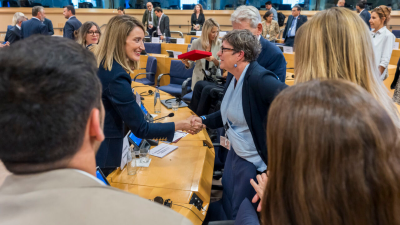
Investing in regions with cohesion policy for a more competitive Europe
ERRIN joined regional leaders from the EUregions4cohesion coalition and Members of the European Parliament to debate the future of Cohesion Policy in the 2028–2034 EU budget. The coalition presented its new position paper, which includes recommendations on place-based innovation, smart specialisation and the European Semester.
- By Martina Campajola
ERRIN and its members call on the Commission to safeguard the EU Missions and mission-oriented approach in the next MFF
More than 35 regional and local authorities urge EU decision-makers to keep the EU Missions running until at least 2030 and to keep the mission-oriented approach at the heart of Europe's future research and innovation framework. The letter underlines the strategic importance of preserving and strengthening the EU Missions and the mission-oriented approach as central pillars of Europe's competitiveness, resilience and innovation agenda.