
27 National Adaptation Hubs launched across Europe: a new milestone for multilevel climate adaptation governance
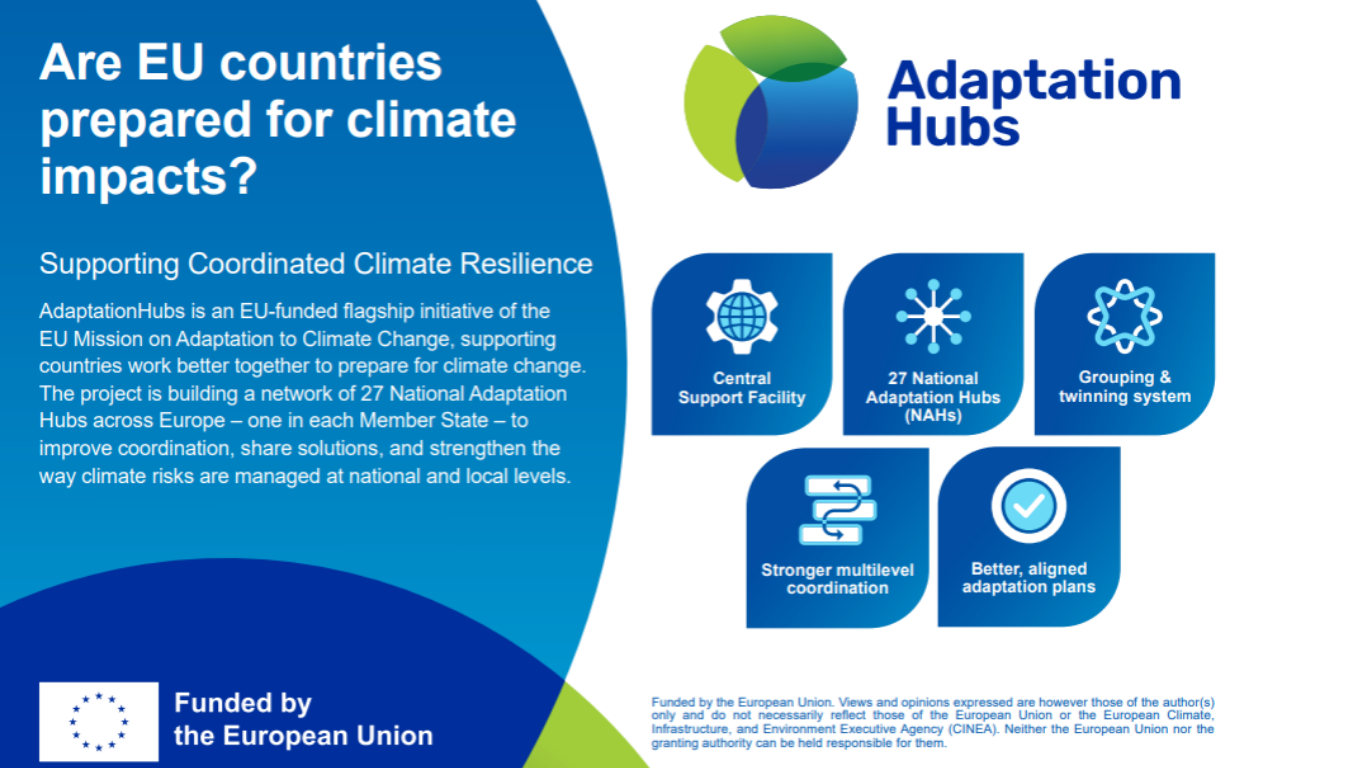
All 27 National Adaptation Hubs (NAHs) are now live, one in each EU Member State. As a flagship initiative of the EU Mission on Adaptation to Climate Change, the AdaptationHubs project, in which ERRIN is among the partners, aims to strengthen coordination between national, regional and local actors and support the implementation of climate adaptation actions across Europe.
Across the EU, regions and municipalities are already experiencing the impacts of climate change, including heatwaves and droughts, flooding, coastal erosion, and water scarcity. While adaptation measures are often implemented locally, the enabling conditions for successful adaptation are shaped across multiple governance levels. National Adaptation Hubs have been established to help bridge this gap, creating permanent structures for dialogue, coordination, and knowledge exchange among governments, regions, cities, experts, and other stakeholders.
Funded by Horizon Europe and coordinated by REGEA, AdaptationHubs brings together 32 partners, including one national expert organisation in each Member State. Over the next two years, these organisations will work with public authorities, regional and local actors, research organisations and civil society to strengthen adaptation governance and improve coordination across levels.
The project has now moved from its set-up phase into implementation. All 27 hubs are operational and have started engaging stakeholders, identifying governance needs and developing activities tailored to their national contexts. The AdaptationHubs website is now fully operational and provides an overview of the project, the national hubs and upcoming activities.
Regional and local stakeholders play a crucial role in climate adaptation. They are often the first level of government to address climate impacts and implement adaptation measures on the ground. Yet, adaptation challenges frequently require coordination beyond administrative boundaries and sectors. The National Adaptation Hubs are designed to address this challenge by strengthening multilevel governance and creating stronger links between national adaptation priorities and local realities. Through workshops, peer-learning activities, twinning opportunities and knowledge exchange, the hubs aim to support more coherent and effective adaptation policies and actions. ERRIN members are encouraged to identify the organisation responsible for their country's National Adaptation Hub and get involved in the upcoming activities. Participation in the hubs offers an opportunity to contribute regional and local perspectives, exchange experiences with peers and help shape national adaptation priorities.
AdaptationHubs is part of a broader trend across the EU Missions, recognising that ambitious European objectives require stronger coordination between governance levels.
As a partner in AdaptationHubs, ERRIN plays a key role in supporting the implementation of National Adaptation Hubs across Europe. ERRIN leads the coordination and monitoring of activities in several countries (Austria, Belgium, Germany, Ireland, Luxembourg, Netherlands), supports transnational exchanges and peer-learning activities, and contributes to communication and dissemination efforts. Central to this is ensuring that regional and local perspectives are fully reflected in the development of the hubs and in the broader implementation of the Adaptation Mission. As the project enters its implementation phase, ERRIN looks forward to working with its members and partners to strengthen adaptation governance across Europe and help turn climate adaptation strategies into concrete action.
ERRIN is also involved in two other flagship Mission projects built around a similar model:
- CapaCITIES 2.0, supporting EU Climate Neutral and Smart Cities Mission through the creation or development of national platforms and strengthened multilevel governance for climate-neutrality cities;
- ECHoS II, supporting the EU Cancer Mission through the establishment of a network of National Cancer Mission Hubs that connect national, regional and local stakeholders.
Together, these initiatives reflect a growing recognition that Missions can only succeed if European priorities are translated into coordinated action across national, regional and local levels.
- Gaia Ialisa Marotta
- 16/06/2026
-
Working Group