
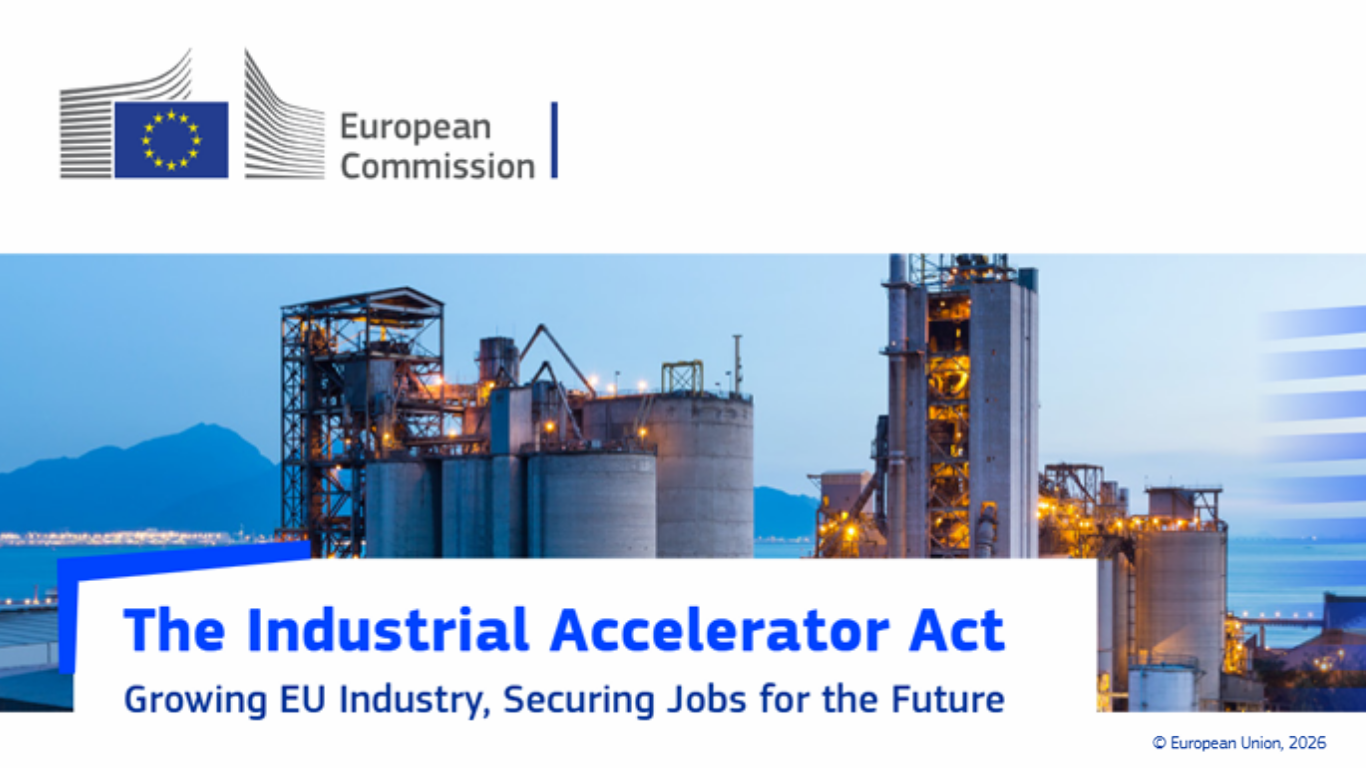
ERRIN calls for a place-based Industrial Accelerator Act built on regional innovation ecosystems
ERRIN has submitted its contribution to the European Commission’s public consultation on the Industrial Accelerator Act (IAA), highlighting the crucial role of regional and local authorities, innovation ecosystems and place-based industrial transformation in delivering Europe's competitiveness and decarbonisation ambitions.
While welcoming the Commission’s efforts to accelerate industrial deployment, strengthen strategic value chains and reduce dependencies, ERRIN stresses that industrial acceleration cannot be achieved through regulatory simplification alone. Europe's competitiveness is built on regional strengths, industrial clusters, research organisations, SMEs and local ecosystems that translate European ambitions into concrete industrial projects and investments.
Industrial acceleration starts in regions
ERRIN's input underlines that Industrial Manufacturing Acceleration Areas (IMAAs) should be rooted in regional industrial ecosystems and innovation capacities. Regional and local authorities should play a structured role in the designation, governance and implementation of these areas to ensure that investments build on genuine territorial strengths and stakeholder ownership.
The network also emphasises that acceleration areas should not operate as isolated industrial zones. Instead, they should function as interconnected nodes within European value chains, fostering cooperation between regions with complementary strengths and reinforcing industrial resilience across Europe.
Building on existing ecosystem initiatives
ERRIN calls on the Commission, the European Parliament and the Council to build on successful ecosystem-based initiatives already operating across Europe, including Net-Zero Acceleration Valleys, Regional Innovation Valleys, Hydrogen Valleys and relevant initiatives from the European Partnerships.
In particular, Net-Zero Acceleration Valleys provide valuable experience in developing place-based industrial ecosystems that combine industrial deployment, innovation, skills development, infrastructure and investment mobilisation. The IAA should build on and expand these approaches while avoiding fragmentation between different policy initiatives.
SMEs, skills and policy coherence
Our input also highlights the importance of ensuring that SMEs and other small actors can participate in emerging strategic value chains. This requires more than simplified permitting procedures: innovation support, demonstration facilities, access to finance and stronger engagement in ecosystem-based collaboration projects are equally important.
ERRIN further stresses that industrial acceleration must be accompanied by investments in skills and talent. Regional skills ecosystems involving industry, universities, vocational education providers and research organisations are essential to support the deployment and scale-up of strategic technologies. Stronger links between industrial, research and innovation, cohesion, skills and circular economy policies will also be necessary to maximise Europe's long-term competitiveness.
Industrial Accelerator Act and the next EU budget
A central message of ERRIN's contribution is that the success of the Industrial Accelerator Act will depend on a coherent investment framework under the next Multiannual Financial Framework (MFF). The network therefore calls for stronger alignment between the IAA, the future Horizon Europe (FP10), the European Competitiveness Fund (ECF) and future National and Regional Partnership Plans (NRPPs). Europe needs a seamless pathway from R&I to demonstration, deployment, manufacturing and market uptake.
This message is fully aligned with ERRIN's amendment proposals for FP10 and the ECF, which advocate for stronger support to regional innovation ecosystems and better connections between R&I, industrial deployment and territorial development.
For ERRIN, industrial competitiveness, resilience and strategic autonomy will only be achieved if Europe fully mobilises the strengths of its regions and innovation ecosystems. The Industrial Accelerator Act provides an opportunity to place territories at the heart of Europe's industrial future.
- Silvia Ghiretti
- 19/06/2026