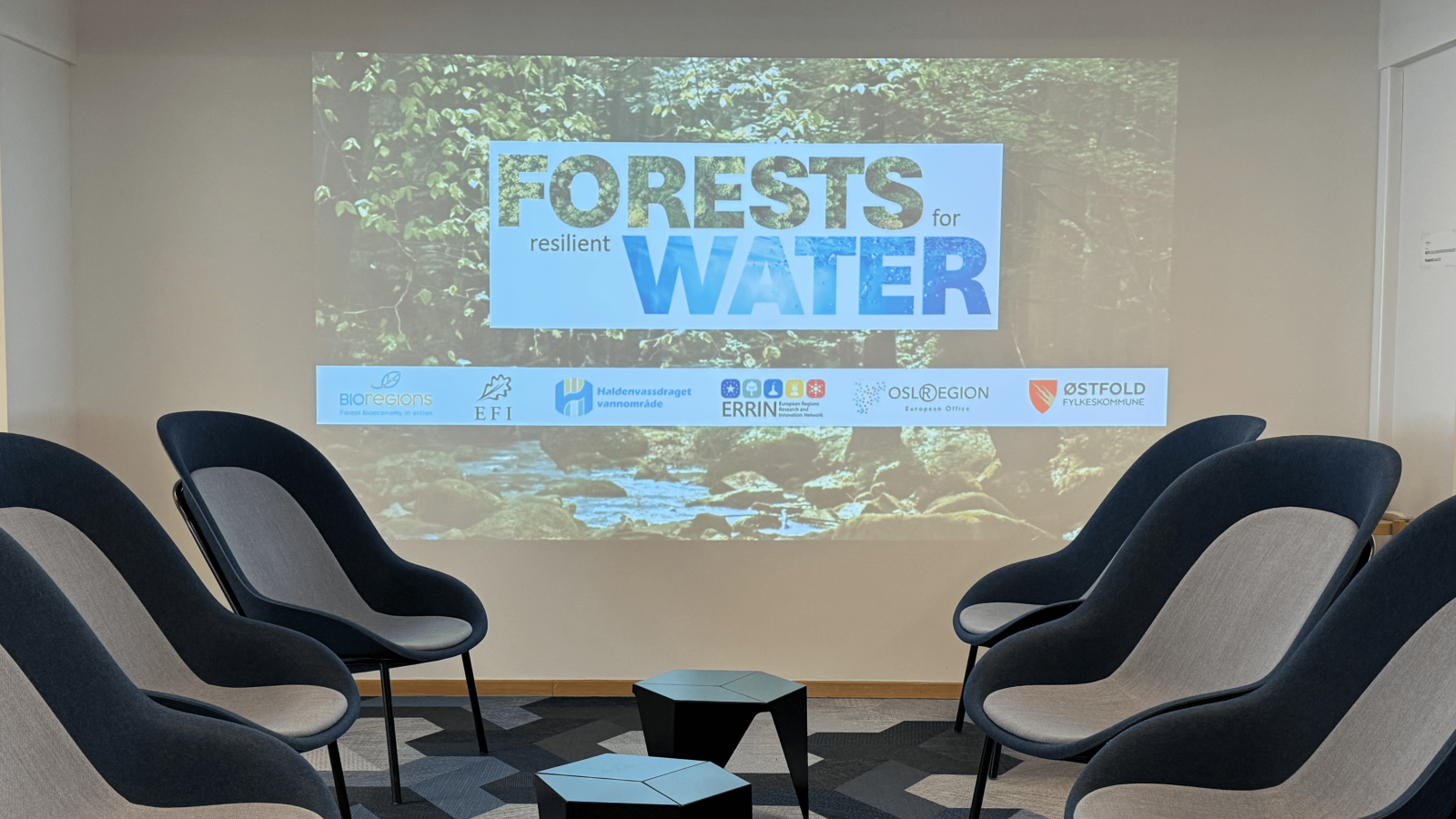
Forests for Resilient Waters: an exchange on the regional perspective
On 23 April, the Oslo Region EU Office brought together policymakers, researchers and regional practitioners to explore the role of forests in protecting and restoring Europe's water cycle. Organised by the Halden River Basin Sub-District with the EFI Bioregions Facility, the European Forest Institute, ERRIN, the Oslo Region European Office and Østfold fylkeskommune, the event placed regional voices at the centre of an increasingly urgent debate.
Policy-Science Framework
Anders Iversen (DG Environment) and Professor Bart Muys (KU Leuven) mapped the policy and scientific landscape. Iversen presented the different EU policy files referencing forests, including the Nature Restoration Regulation or the EU Water Resilience Strategy. He highlighted the high water retention potential of forests, which makes them prime examples of 'sponge systems'.
Bart Muys, KU Leuven, presented tensions holding forest management back: 'business as usual' where incentives are absent and EU biodiversity rules can be too rigid for climate-smart approaches. Mixed forests outperform monocultures under climate stress and deliver more ecosystem services but are costlier to manage. The underlying challenge, both speakers agreed, is that EU regulations address forests, water, biodiversity, and climate from different angles with sometimes competing objectives. That balancing act falls, inevitably, to the regional level.
The regional perspective
ERRIN presented what it means for regional authorities in practice. From the Natural Resources and Adaptation Cluster, including the Bioeconomy, Blue Economy and Climate Adaptation and Resilience Working Groups, Gianpiero Petruzziello and Ana Nava Tazo highlighted that the forest-water nexus plays out directly in regional planning, from river basin management plans to climate adaptation strategies.
Regions are increasingly called upon to integrate nature-based solutions, strengthen ecosystem services and ensure that forests contribute to water retention, flood prevention and drought resilience. This also involves engaging local stakeholders and leveraging EU funding instruments to implement integrated, place-based solutions.
ERRIN pointed to concrete entry points for regional engagement: the Water Smart Territories initiative, the Cohesion for Transitions Community of Practice, and the Regional Alliance for Water Resilience. Upcoming Horizon Europe funding calls under the Missions on Ocean & Waters, Soil and Climate Adaptation, as well as Horizon Europe Cluster 6, were flagged as opportunities for regions to bring local forest-water actions forward.
A new Partnership for Forests
Mika Kallio (Finnish Ministry of Agriculture and Forestry) presented the upcoming EU Partnership FOREST (Forests, Forestry and the Forest-Based Sector: Research and Innovation for a Sustainable Transition), approved under Horizon Europe and set to launch in Helsinki in October 2026. Spanning ten years and gathering over 100 organisations from 28 countries, it will run seven international joint calls funding 200–250 projects, with Living Labs as a key collaboration format. For regions and research organisations, it is a new opportunity for place-based multifunctional forest management to be tested and scaled.
Regional cases: From Norway to the Basque Country and Slovakia
Three case studies illustrated what forest-water management looks like on the ground. The Halden Canal District presented a catchment where agricultural nitrogen runoff is driving coastal eutrophication. Practical responses include peatland restoration on post-harvest land, retention dams to buffer peak flows and riparian zone restoration for flood mitigation and biodiversity. The conclusion: tools exist, but implementation is hard when land is split between owners with different interests.
LIFE URBASO, a LIFE-funded project in the Urdaibai Biosphere Reserve (Basque Country), showed how forest management can directly protect drinking water quality. Where post-industrial pine and eucalyptus plantations drive sediment runoff into catchments (raising purification costs and risks), the project is converting monocultures into mixed, multi-aged forests through native reforestation and underplanting. The project is also calculating cost-benefit ratios for ecosystem services, building a replicable model for Atlantic catchment contexts across Europe.
A third perspective came from NGO People & Water (Slovakia), presenting work from the Ronava River Basin on estimating the forestry benefits of water retention measures. Their methodology (calculating runoff volumes, mapping where and when water moves and targeting retention interventions accordingly) offers a framework for engaging private landowners in restoration by quantifying how different land-use types shape the hydrological profile of a landscape, thus enabling concrete forest-based solutions to be developed.
For more on ERRIN's work in this area, check the Natural Resources and Adaptation Cluster page, including its Annual Plan and upcoming opportunities to engage. If you have specific questions, you can contact Ana Nava (ana.nava@errin.eu) or Gianpiero Petruzziello (gianpiero.petruzziello@errin.eu)