
The federal state Bremen is a two-city-state consisting of the cities of Bremen and Bremerhaven. The region has a long tradition of combining trade, commerce and innovation. With expertise in areas from maritime services, logistics and aerospace engineering to clean energy (esp. wind and hydrogen) and automotive, the economy is well prepared for the future. Bremen is also a key player in digitisation, Industry 4.0 and the creative industries. The representation in Bruxelles was established in 1987.
Contact detail
-
Contact person
-
Brussels Office Address
Avenue Palmerston 22
1000 Brussels
Belgium
S3 Strategy
Strategic Specialization takes place via the innovation strategy of the state of Bremen 2030 on the basis of the key innovation fields:
- Sustainable economy and resource efficiency
- Networked and adaptive industry
- Mobility of the future
- Intelligent services
- Digital transformation.
Each of the innovation fields focuses on specific societal challenges and addresses them with strategic objectives. In doing so, the particular regional strengths in the economic and innovation system of the state of Bremen are taken up and cross-industry specialization profiles are elaborated. Unlike in the past, the interfaces between sectors are emphasized and new target groups for innovation policy measures are brought into view. The operational goals and measures (chapter 4) refer to all fields of innovation. With the key innovation fields, the innovation policy of the state of Bremen will be positioned in such a way that it can respond quickly and appropriately to global trends, new technological developments and processes of social change. In this way, the necessary course is to be set by 2030 in order to increase the competitiveness of Bremen and Bremerhaven. More information.
Strategic R&I Projects
TitleSpaceUP
Throughout the project lifetime six Space Academies will take place in various locations in Europe, networking new space tech entrepreneurs with potential partners and customised business services will be provided to selected companies, helping them accel
WEBSITE>Public Policy Living Laboratory (P2L2)
The Public Policy Living Lab (P2L2) project supports countries and regions invested in the field of advanced materials by introducing or improving local policy to support innovation in this field.
WEBSITE>CHARTER, the European Cultural Heritage Skills Alliance, brings together and represents the whole range of the cultural heritage sector in Europe. We strive towards making apparent the value of cultural heritage and creating a resilient and responsive sector. ERRIN is also a partner in the CHARTER project.
WEBSITE>
Urban Logistics as an on-Demand Service (ULaaDS)
The vision is to foster sustainable cities through the deployment of innovative logistics, while dealing with the impact of the on-demand economy. Three municipalities committed to zero emissions city logistics – Bremen, Mechelen and Gr
WEBSITE>ERRIN activities
Management Board members

Latest Updates
- By Astrid Hannes
CHARTER Alliance presents the 8 education and training pathways and curricula for the future of cultural heritage
CHARTER, the European Skills Alliance for Cultural Heritage, presents eight innovative and emerging training pathways for the future of the cultural heritage sector. The full report contains information for Education and Training providers, ranging from EQF level 3 to 8, to innovate their Education and Training offer. It highlights examples of emerging occupations and professional profiles, learning outcomes, and recommended curricula outlines.
- By Astrid Hannes
How is cultural heritage integrated into regional development? CHARTER Alliance publishes new report on six regional case studies conducted by ERRIN
CHARTER, the European Cultural Heritage Skills Alliance funded by Erasmus+, has released a new report showcasing findings and conclusions from six regional case studies conducted by ERRIN members in the Basque Country (Spain), Sibiu (Romania), Bremen (Germany), Alentejo (Portugal), Tuscany (Italy), and Västra Götaland (Sweden) in 2021-2023. The report synthesises how skills for cultural heritage are integrated into regional development policies and strategies, examining sector-integrated dynamics within these regional ecosystems. The report provides recommendations for developing long-term regional skills policies, enhancing skills governance and strengthening skills intelligence at the regional level through data-driven policies.
- By Astrid Hannes
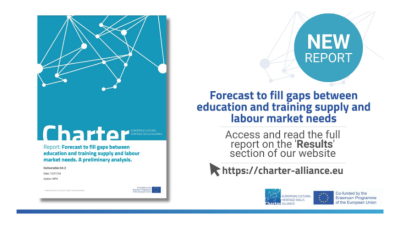
New CHARTER Report: Forecast to fill gap in Heritage Education and Training
In its new report, "Forecast to fill gaps in Heritage Education and Training", the CHARTER EU Alliance delves into the gaps and needs of Cultural Heritage professionals in Europe. This report maps the main challenges for professional development in heritage, encompassing technology, sustainable development, professional collaboration, public administration, diversity, funding, social uses, knowledge transfer, occupation coding, and skills description.

- By Francesca Pozzebon
Join the ERRIN Cultural Heritage and Tourism WG: Call for a new leader
The Cultural Heritage and Tourism Working Group is looking for a new working group leader with an EU Tourism policy focus to join the Working Group leadership.
- By Astrid Hannes
CHARTER Alliance releases a new report on cultural heritage stakeholders’ roles and dynamics
CHARTER Alliance publishes a new report mapping cultural heritage stakeholders, looking at cultural heritage as an economic sector and labour market with interacting stakeholders in anticipated roles, whose dynamics, skills and competencies will affect the quality of heritage as a resource and common good.
- By Agnieszka Wieczorek Jetha
ERRIN as a part of a blueprint alliance – the CHARTER project
ERRIN is part of the successful CHARTER consortium led by the University of Barcelona to develop sectoral skills, funded by the Erasmus+ programme. As part of the consortium, ERRIN also involves five members of the Cultural Heritage and Tourism Working Group to take part in the project’s regional activities.