
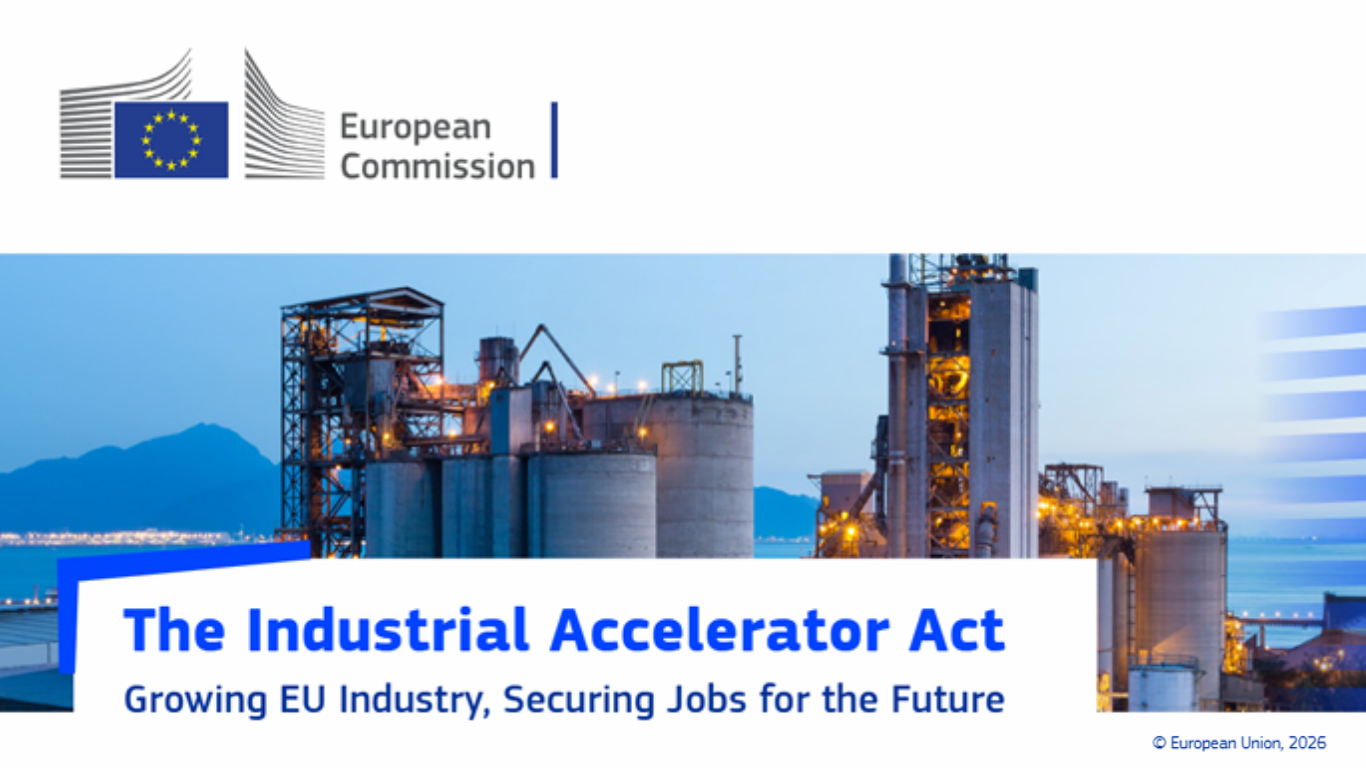
ERRIN calls for a stronger regional dimension in the Industrial Accelerator Act
ERRIN welcomes the European Commission’s proposal for an Industrial Accelerator Act as an important step towards strengthening Europe’s industrial competitiveness, resilience and decarbonisation. In particular, ERRIN supports the ambition to increase strategic manufacturing capacity and establish Industrial Manufacturing Acceleration Areas as vehicles for industrial deployment.
However, successful industrial acceleration will depend on how effectively EU action connects with the regions where industrial ecosystems, companies, research organisations, skills and innovation are already concentrated. ERRIN has therefore developed a series of amendment proposals, co-developed with its members, to reinforce the territorial dimension of the Regulation, building on ERRIN’s contribution to the European Commission’s public consultation.
Putting regions at the heart of industrial acceleration
ERRIN's amendments call for stronger multi-level governance, with regional and local authorities involved alongside national authorities, industry, research organisations, higher education institutions, VET providers and other innovation ecosystem actors, particularly in the designation of Industrial Manufacturing Acceleration Areas. These areas should build on existing regional industrial capabilities, innovation assets and ecosystem maturity, with regional authorities effectively involved throughout the designation process.
Building on Europe’s existing innovation ecosystems
ERRIN’s amendments call for stronger links between Industrial Manufacturing Acceleration Areas and existing place-based initiatives, including Regional Innovation Valleys and Hydrogen Valleys, as well as other relevant EU-supported ecosystem initiatives. Building these connections into the IAA would help maximise existing investments, strengthen synergies, avoid fragmentation and facilitate cooperation across sectors and regions.
Ensuring SMEs and skills are part of the transition
ERRIN’s proposals also highlight the importance of ensuring that SMEs can effectively participate in industrial transformation. Skills are another essential element. ERRIN proposes that education and training opportunities linked to Industrial Manufacturing Acceleration Areas should be developed in cooperation with regional authorities, higher education institutions, VET providers, research organisations and industry.
Strengthening Europe’s manufacturing capacity
ERRIN's amendments also address the Union Origin criteria for net-zero technologies, arguing that the current approach could allow products manufactured outside the EU to qualify as Union-origin content. The proposed changes aim to give demand-side measures under the IAA clearer incentives and guarantees for European manufacturing, strengthening the resilience of European cleantech supply chains.
European Parliament draft report now out
The European Parliament's draft report on the IAA has now been published, marking an important next step in the legislative process. A first look shows a mixed picture for ERRIN's proposals. On Union Origin and manufacturing content, several of ERRIN's concerns have been taken into account, with the report tightening the definition of Union origin and setting stricter conditions for when third-country content can be treated as equivalent. On the territorial dimension, progress is more limited: the draft report now requires Member States to designate acceleration areas in cooperation with regional and local authorities, and introduces a mandatory consultation step before designation, but it does not yet give regions a structured role throughout the process, nor does it reference Regional Innovation Valleys or Hydrogen Valleys, as ERRIN had proposed.
The report is open to amendments until the end of September 2026. If you are working on this file and would like to contribute or align positions, please reach out to Silvia.
- Silvia Ghiretti
- 08/09/2026