Introduction to the project
The RESIST project is a five-year EU-funded project which aims to support twelve regions across the EU in their efforts to build resilience against the impacts of climate change.
Three ERRIN members, Southwest Finland, Central Denmark, and Catalonia, along with the fourth region of Central Portugal, will serve as the frontrunner regions known as Large-Scale Demonstrators (LSDs).
These regions will test adaptation solutions to key climate-related challenges in their areas. They will lead the way paired with two other regions facing similar issues.
The project will enhance the resilience, speed up the transformation, and boost the adaptive capacity of climate-vulnerable regions. RESIST will also facilitate the transfer of know-how and innovative solutions, incorporating a market-oriented approach for their wider and sustainable exploitation.

Project in Action
As part of the EU Mission Adaptation to Climate Change RESIST will engage European regions with different socioeconomic profiles that will test adaptation solutions to five key climate challenges: floods, droughts, heatwaves, wildfires, and soil erosion.
Know-how and adaptation pathways tested in the leading regions will be shared with eight twinned regions through mutual-learning activities and immersive digital twins.
The project follows the quintuple helix model, which involves civil society organisations (CSOs), the private sector, policy makers, and the scientific community through a cross-sectoral and bottom-up approach.

ERRIN’s Role
ERRIN is responsible for supporting the 12 regions in implementing their climate-related innovations. Additionally, ERRIN's role in the project includes developing a Community of Practice and identifying the needs for a mutual-learning scheme. ERRIN will also connect Large Scale Demonstrators and Twinning regions with a wider Community of Interest or EU regions with similar Climate Adaptation challenges.
Under ERRIN coordination and through an Advisory Board, the project will setup interface to policy-makers in the field of climate change adaptation in the European institutions, national and regional governments and other relevant programmes, projects and initiatives.


Benefit for members and links with ERRIN's WGs and priorities
The majority of the RESIST regions are also actively engaged in the ERRIN Climate Adaptation Task Force, which enables information sharing, project development and peer learning. Indeed, the RESIST project is funded under the EU Mission on Adaptation to climate change, which is the main focus of the ERRIN Adaptation Task Force.

Latest Updates

- By Martina Campajola
Strong regions, strong Europe: ERRIN at the European Week of Regions and Cities 2026
ERRIN spent the European Week of Regions and Cities moderating sessions, following debates and meeting more than a dozen member delegations. Here is a selection of the moments closest to our priorities, from the EU Missions and the next MFF to talent, culture and competitiveness.
- By Silvia Ghiretti
The European Commission publishes the EU Missions mid-term assessment
On 14 September, the European Commission published its mid-term assessment of the EU Missions, highlighting progress across all five Missions and recognising the mission-oriented approach as an effective model for addressing complex societal challenges. For ERRIN, the assessment reinforces the case for maintaining and strengthening the Missions in the next EU long-term budget, while ensuring that the next phase is better equipped to translate research and innovation into deployment, scale-up and territorial impact.

- By Ana Nava
ERRIN submits input to the Water Resilience R&I Strategy consultation
ERRIN has submitted a response to the EC's Call for Evidence on the Water Resilience Research and Innovation Strategy. The response focuses on the central role of local and regional authorities in achieving water resilience. This input will be presented at a members' meeting on Thursday 24 September at 14:00 CEST, at ERRIN's Brussels office. The session will include an exchange with a representative of the Mission Ocean and Waters Secretariat.

- By Zoé Thomazeau
Discover ERRIN's autumn 2026 activities
ERRIN’s revised Annual Plans for 2026 are now available, outlining the upcoming activities, priorities and opportunities for engagement across ERRIN’s Working Groups for the remainder of the year. Each year, ERRIN’s member-led Working Groups develop Annual Plans that set out their strategic priorities, planned activities and key objectives. Shaped by members’ feedback and expertise, these plans ensure that ERRIN’s work remains closely connected to the needs and priorities of its regional and local innovation ecosystems.
- By Gaia Ialisa Marotta
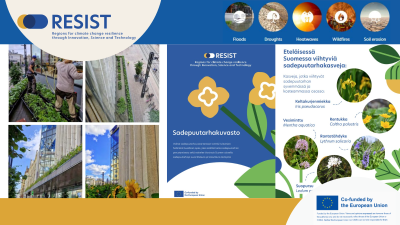
Raingarden Catalogue supports citizen uptake of nature-based solutions in Southwest Finland
As part of the RESIST project, Southwest Finland has launched a new Raingarden Catalogue to help citizens better understand and implement nature-based solutions (NbS) for stormwater management on private properties. The publication introduces raingardens as an effective tool to improve local stormwater management while delivering additional benefits for biodiversity and urban resilience. It also connects homeowners with companies offering design and implementation services, making it easier to move from awareness to action.
- By Gaia Ialisa Marotta
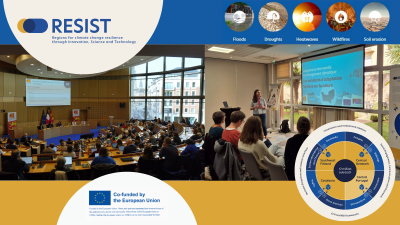
Normandy advances climate adaptation through coordinated governance and regional action
Climate adaptation requires coordinated action across governance levels, from local authorities to European institutions. In the French region of Normandy, this approach is taking shape through a regional strategy that brings together municipalities, public authorities, research organisations and European initiatives to address growing climate risks.