Our Brussels-based office represents the Regional Council's departments (Research, Industries, Digital, Mobility, Education & training, Environment & Climate change, Agriculture...) as well as regional stakeholders (Innovation agency, clusters, universities, association, local authorities).
Contact detail
-
Contact person
-
Brussels Office Address
Rue Montoyer 21
1000 Brussels
Belgium
S3 Strategy
Main S3 priorities in Nouvelle-Aquitaine include Advanced Materials, ASD sectors, Chemistry, Health & Silver economy, Blue Growth, Agro innovation, Forests industries, Photonics, Geosciences.
Strategic R&I Projects
M-ERA-NET
M-ERA.NET is an EU funded network that has been established to support and increase the coordination of European research programmes and related funding in materials science and engineering.
WEBSITE>
P2L2 - Public Policy Living Lab
The Public Policy Living Lab (P2L2) project supports countries and regions invested in the field of advanced materials by introducing or improving local policy to support innovation in this field.
WEBSITE>
NewSkin
NewSkin: Innovation Eco-system to Accelerate the Industrial Uptake of Advanced Surface Nano-Technologies. OITB to provide the necessary technologies, resources and services to uptake a set of innovative processes to manufacture nano-enabled industrial and consumer products as well as testing capabilities to demonstrate nano-enhanced goods features.
WEBSITE>
Space2IDGO
SPACE2IDGO aims to export European space innovation to third countries (China, United Arab Emirates, Canada, Columbia and Chile) via the use of satellite data from earth observation, geopositioning and telecommunications.
MAGIC SWF SMEs 20-21
The project aims to raise the competitiveness of SMEs from South-West France by offering services linked to innovation management.
WEBSITE>Latest Tweets
Latest Tweets
Latest Updates
- By Intern SMR
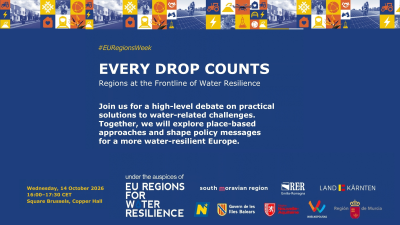
EU Regions Week Session Every Drop Counts: Regions at the Frontline of Water Resilience
Join EU Regions Week Session called Every Drop Counts: Regions at the Frontline of Water Resilience. The session will explore how regions can lead Europe’s response to growing water-related risks and strengthen climate adaptation through place-based solutions. High-level representatives from eight European regions will share practical approaches to water retention, quality and quantity, agriculture, tourism and preparedness.
- By Martina Campajola
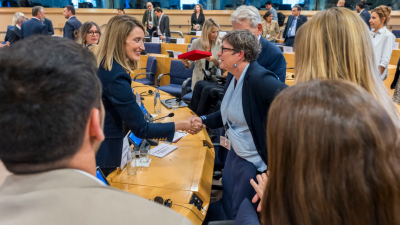
Investing in regions with cohesion policy for a more competitive Europe
ERRIN joined regional leaders from the EUregions4cohesion coalition and Members of the European Parliament to debate the future of Cohesion Policy in the 2028–2034 EU budget. The coalition presented its new position paper, which includes recommendations on place-based innovation, smart specialisation and the European Semester.
- By Martina Campajola
ERRIN and its members call on the Commission to safeguard the EU Missions and mission-oriented approach in the next MFF
More than 35 regional and local authorities urge EU decision-makers to keep the EU Missions running until at least 2030 and to keep the mission-oriented approach at the heart of Europe's future research and innovation framework. The letter underlines the strategic importance of preserving and strengthening the EU Missions and the mission-oriented approach as central pillars of Europe's competitiveness, resilience and innovation agenda.
- By Zoé Thomazeau
ERRIN members to host events at the European Week of Regions and Cities 2026
The European Week of Regions and Cities, taking place in Brussels from 12–14 October 2026, will once again serve as a leading platform for dialogue on regional and urban policy in Europe. This year the motto is 'Strong regions, strong Europe'. ERRIN is pleased to announce that its members will be strongly represented in this year’s programme, with sessions addressing a wide range of topics relevant to Europe’s regions and cities.
- By Gaia Ialisa Marotta
ERRIN contributes to EU consultation on European Climate Resilience Framework
ERRIN has contributed to the European Commission’s consultation on the future Climate Resilience Framework, calling for climate resilience to become a core pillar of Europe’s competitiveness. Drawing on input from its members and experience from projects such as RESIST, Pathways2Resilience and Adaptation Hubs, ERRIN emphasises the need for a mission-oriented, place-based approach that empowers regions as co-designers, strengthens multi-level governance and ensures better links between innovation, funding and large-scale deployment of adaptation solutions.

- By Silvia Ghiretti
15 Hydrogen Valleys receive project development support: 11 in ERRIN regions
On 16 October, 15 Hydrogen Valleys were awarded Project Development Assistance (PDA) from Hydrogen Valleys Facility to help further develop and strengthen their project concepts. ERRIN is pleased to note that 11 of these Valleys are located in ERRIN member regions.