
Latest Updates

- By Astrid Hannes
Four years on: Celebrating Circular Cities and Regions Pilots’ achievements in driving circular change across Europe
Local and regional authorities across Europe are increasingly committed to the circular economy, yet many still ask the same question: what does implementation look like in practice? A new publication of the Circular Cities and Regions Initiative (CCRI) presents circular systemic solutions which were implemented by twelve Circular Pilot Cities and Regions from 2022-2025. Providing concrete answers and pathways for replication, the pilot solutions span different territorial contexts – from small municipalities to large regions – and cover a wide range of value chains, including construction and the built environment, circular resource management, bioeconomy and nutrient recovery, consumer goods, packaging and food systems.

- By Astrid Hannes
New report: Circular Cities and Regions Pilot Solutions: Insights, impacts, and replication paths
From 2023 until 2025, the Circular Cities and Regions Initiative has supported 12 European cities and regions to test what it really takes to turn circular economy ambition into practical, local and systemic solutions. Their examples in developing Circular Systemic Solutions (CSS) across various sectors and focus priorities form the foundation of this booklet. This compilation brings together the insights and solutions developed through the CCRI Pilot programme between January 2023 and October 2025. It highlights not only what the Pilots achieved, but how they did it: the partnerships they built, the barriers they faced, the tools they used and developed and the lessons that can help others accelerate their own transitions.

- By Astrid Hannes
Get inspired by success stories of the Circular Cities and Regions Initiative
During an online webinar on 11 December, 12 success stories of regions and cities that piloted circular systemic solutions in their territories with support of the Circular Cities and Regions initiatives were presented. We encourage ERRIN members to check the recordings of this webinar, as the lessons learned and experiences shared can inspire other local and regional authorities to launch new local and regional circular initiatives across Europe.
- By Lucy Hammond
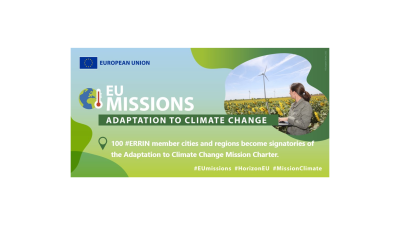
100 ERRIN member cities and regions become signatories of the EU Mission for Adaptation to Climate Change Charter
During the recent European Research and Innovation Days, the European Commission announced the 2nd wave of signatories to the EU Mission for Adaptation to Climate Change Charter, with a further 100 regions and local authorities signing. Of the now 215 signatories, a staggering 100 are associated with ERRIN member cities and regions.

- By Hilary Webb
Wallonian society develops stamp to teach children hand hygiene
COLOP Arts and Crafts, a Wallonian society, has developed a stamp to help teach children about washing their hands, in light of the COVID-19 crisis.
- By Hilary Webb
Wallonian businesses work together to innovate against coronavirus
The Wallonia Export-Investment Agency (AWEX), has assembled examples from the region of businesses working together to tackle the COVID-19 outbreak.