ERRIN contributes to the only session clearly addressing the place-based dimension at the EU R&I Days 2025
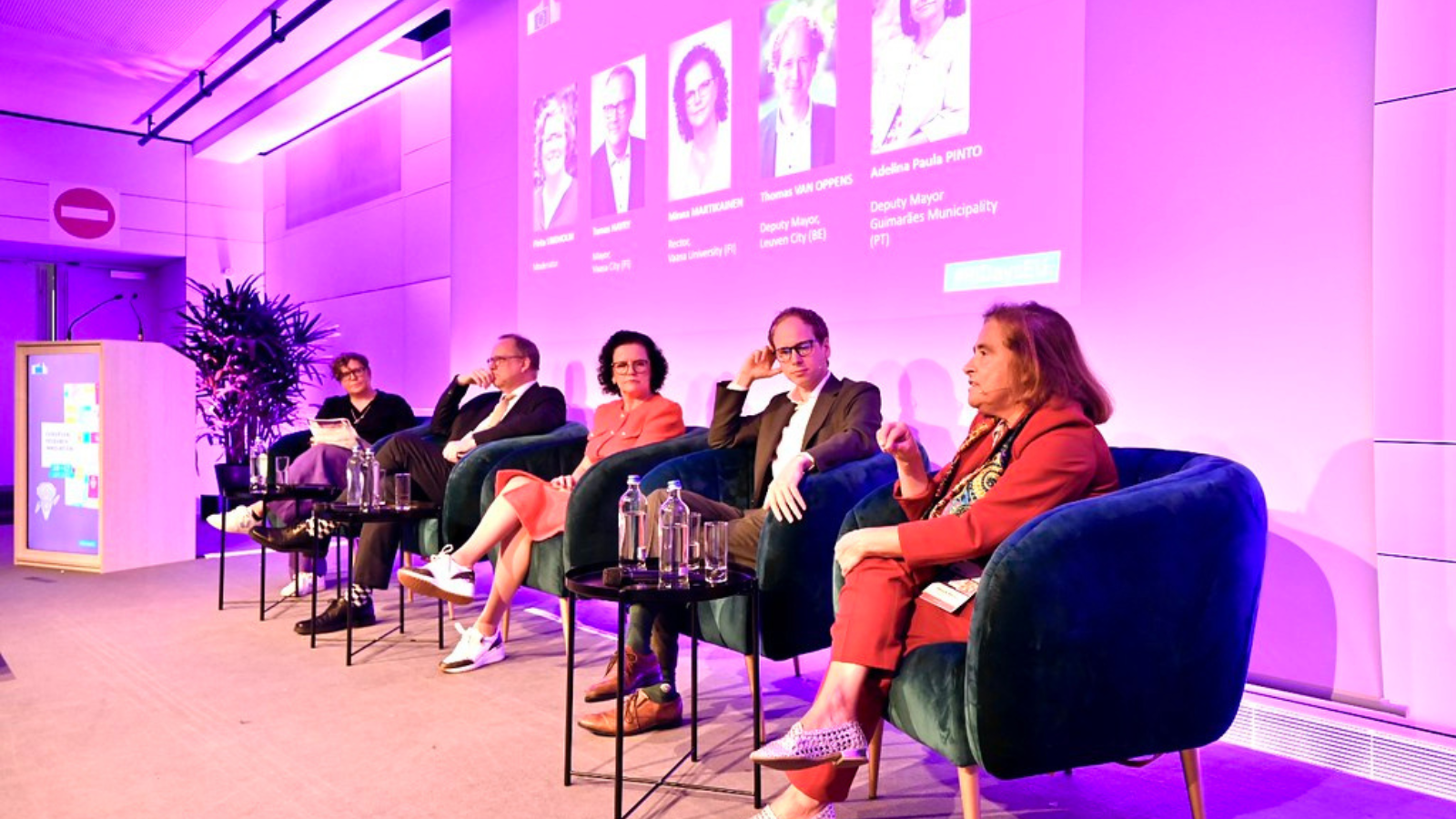
On 17 September, ERRIN’s Director Pirita Lindholm moderated the Cities of Tomorrow session at the European Research and Innovation Days 2025, joined by representatives from ERRIN members' innovation ecosystems. This was the only session during the event to explicitly address the place-based dimension of EU research and innovation.
The panel brought together Tomas Häyry, Mayor of Vaasa, Minna Martikainen, Rector of the University of Vaasa, Thomas Van Oppens, Deputy Mayor of Leuven, and Adelina Pinto, Deputy Mayor of Guimarães. Focusing on circularity as a strategy for resilience and competitiveness, they discussed how cities are driving the green transition in practice through place-based innovation and ecosystem collaboration.
Setting the scene: Empowering cities and regions to drive systemic change
Cities and regions are on the frontline of Europe’s green transition – these are the places where EU policies meet reality. It is here that Europe’s innovation ecosystems take shape, bringing together public authorities, universities, industries, start-ups and citizens to test and implement solutions. Yet, their roles are still too often under-recognised in strategic EU-level discussions, such as the ones on the on the next Multiannual Financial Framework (MFF) and the Commission's new Competitiveness policy initiatives, even though they are working tirelessly on the ground to make the transition happen.
Pirita took this opportunity to highlight ERRIN's recent paper on connected regional innovation ecosystems, which argues that Europe’s future competitiveness and green transition depend on how well we tap into local potential and strengthen connected regional and local innovation ecosystems.
Circularity as a strategy for climate neutrality, resilience and competitiveness
The panellists shared concrete examples of how circularity is helping their cities move towards climate neutrality and resilience, and how this creates new competitive advantages.
The City of Leuven, a Fellow city in the Circular Cities and Regions Initiative, has developed a strong focus on circularity as part of its mission journey towards climate neutrality by 2030. Once not even on the agenda, circularity is now central, with initiatives like a materials bank that recovers and reuses materials from demolished buildings. Through Leuven 2030, a partnership model governed by knowledge institutions, the city, industry and citizens, the whole local ecosystem is mobilised to drive systemic change.
As part of its work on the Cities Mission, the City of Vaasa and industry cluster address energy systems at a systemic level, from turning bio-waste into fuel for public transport to integrating energy technology side streams. The University of Vaasa works in constant strategic partnership with the city, integrating research, innovation and stakeholder needs on areas such as sustainable society, energy transition and sustainable business.
The City of Guimarães, a Mission City set to be European Green Capital in 2026 and one of the 12 Pilots in the Circular Cities and Regions Initiatives, focuses on the importance of citizen engagement and social acceptance for climate neutrality measures. The city runs educational programmes on climate change, biodiversity and the circular economy to build new mindsets from an early age. It also works closely with its university to build an innovation ecosystem supporting industry in its green transition.
The panellists highlighted how their engagement in EU city initiatives, such as the Cities Mission and the Circular Cities and Regions Initiative (CCRI), has been instrumental in driving their work. These initiatives have provided a framework to test and scale place-based innovative solutions, explore new forms of governance models and ecosystem collaboration, laying the foundations for systemic transformation at the local level.
What cities need from EU level
In the closing part of the discussion, the panel reflected on what is needed from the EU level and the upcoming MFF to enable systemic transitions:
- Vaasa’s Mayor Tomas Häyry called for expanding the Emissions Trading System (ETS) to city level, arguing it can drive change and support business opportunities for clean technology, as well as implementing recommendations from the Letta and Draghi reports to strengthen Europe’s competitiveness.
Minna Martikainen from the University of Vaasa called for more financial tools and support that brings the entire regional R&I ecosystem together, arguing that an ecosystem approach is crucial for enabling systemic transformation.
- Thomas Van Oppens from Leuven underlined the need to invest heavily and rapidly in alternatives to address climate change and energy dependencies while protecting vulnerable consumers.
- Adelina Pinto from Guimarães highlighted that the EU should believe more in the power of cities and improve access to finance for projects rooted in local ecosystems.
Keeping the place-based dimension on the EU agenda
The European Research and Innovation Days is an annual high-level event in Brussels that brings together key policymakers, researchers, industry leaders and the wider R&I community to connect, exchange ideas and shape the future of Europe’s research and innovation landscape. ERRIN was pleased to contribute to these timely discussions, joining our members to underline the importance of embedding a place-based dimension and an ecosystem approach into EU research and innovation policies.
ERRIN is one of the partners of the Coordination and Support Office supporting the Circular Cities and Regions Initiative (CCRI). Funded by the EU as part of the Circular Economy Action Plan, the CCRI aims to bring the circular economy to life in cities and regions across Europe.
ERRIN has been actively engaged in the development of the EU Cities Missions from the very beginning. ERRIN plays several roles in supporting the implementation of the Cities Mission through the NetZeroCities platform and the CapaCITIES 2.0 project.