The Union of Skills: why the regional dimension matters?
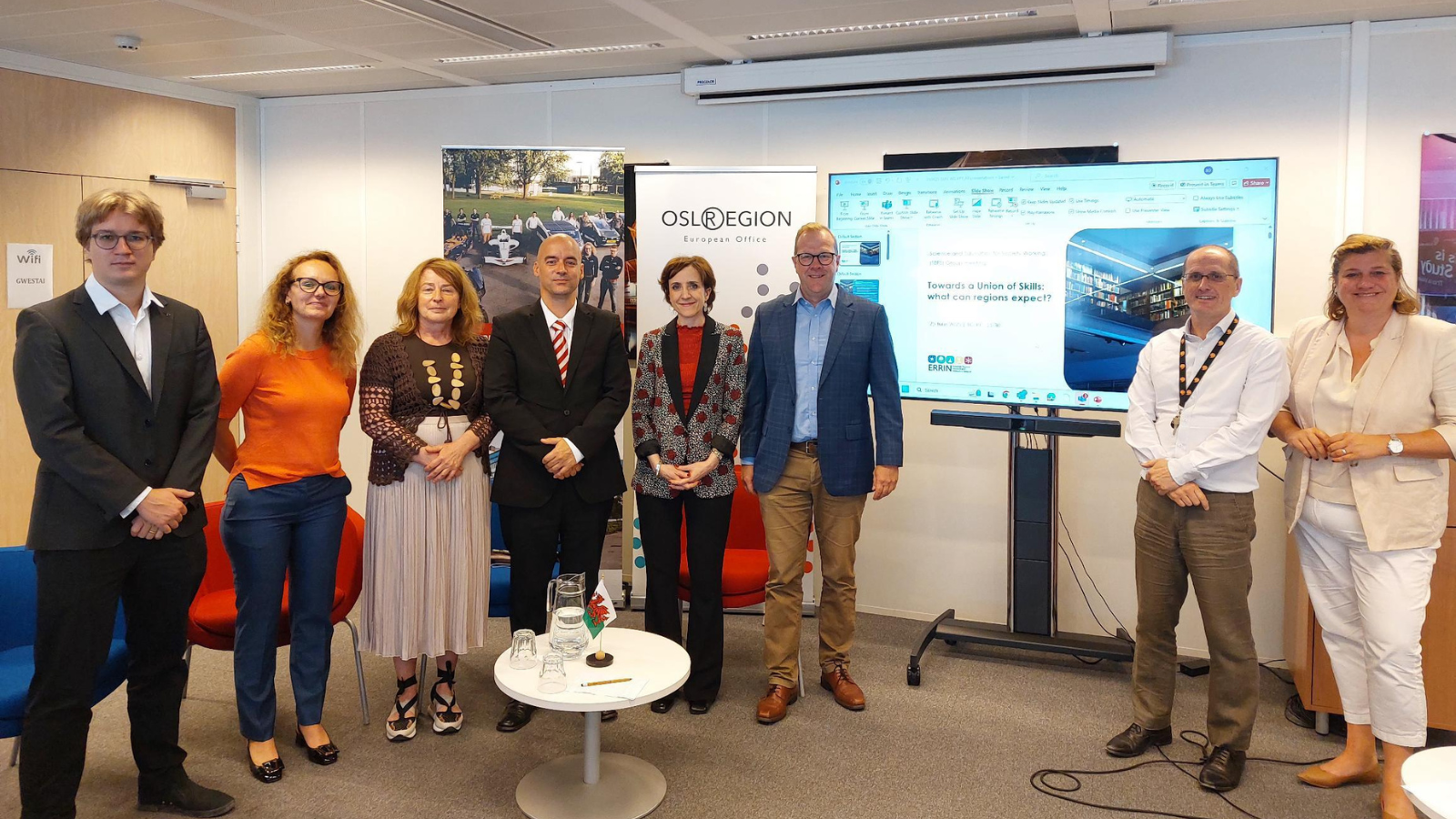
On 25 June, ERRIN's Science and Education for Society (SEFS) Working Group organised an insightful exchange with the Cabinet of Executive Vice-President Roxana Mînzatu, focused on the Union of Skills initiative.
At the opening the meeting, Vanessa Debiais-Sainton, member of the Cabinet, highlighted how increasing basic skills, skills circulation, talent development and attraction as well as strengthening the multi-level governance, are key for achieving the objectives of the Union of Skills. She underlined that regions are essential connectors for accelerating regional skills ecosystems for jobs and education.
Four regional and academic voices showcased why the Union of Skills must embrace Europe's place-based diversity
- Miriana Bucalossi of Tuscany Regional Government (IT) emphasised the importance of granular regional skills intelligence to develop evidence-based and more proactive Education & Training policies, fit for anticipating skills shortages, rather than reactively responding to skills needs. She also highlighted the value of interregional learning on best practices from peers.
- Vegard Herlyng of Kongsvinger College Centre located in Innlandet County (NO), shared its success story of co-designing training programmes from ecosystem's perspective in a rural border region, in close collaboration with the municipalities, the regional Council, employment services and businesses. With short six-week upskilling courses they are reskilled and reactivated unemployed people into local employment.
- Professor Paulo Ferreira representing Portalegre Politecnic University (PT) warned of a 'talent development trap' in a rural and sparsely populated area like Alentejo Region and showcased how intensified collaboration between universities and companies – including on-campus incubators –, a talent fixation strategy and increased efforts to strengthen international collaboration is boosting student enrolment and retention of talent in the region against all odds of a population decline.
- Dr. Ksenija Vidmar Horvat Ljubljana University (SI) brought the perspective of skills development in a widening country and shared how the university is redesigning ecosystems and teaching approaches to increase entrepreneurships and STEAM, calling for a shift in academic cultures for delivering new innovative programmes.
Key takeaway reflections from the meeting
- ERRIN calls for reinforcing the place-based dimension in the roll-out of the Union of Skills, recognising territorial diversity of skills challenges across all regional ecosystems in Europe. Place-based skills challenges, require place-based solutions.
- A ambitious European Skills Observatory should go beyond transnational benchmarking and include granular regional skills intelligence allowing to close skills gaps and address the realities of regional labour markets in all territories across Europe.
- Attracting and retaining talent in Europe's regions, particularly those facing a development trap, requires long-term commitment from the entire ecosystem to ensure competitiveness across the EU.
- Regional authorities can play a central role in building strong regional skills ecosystems, cultivating a culture of trust and adopting news ways of collaboration.
Learn more?
You can find the presentations of the 25 June SEFS WG meeting here. Please note you need to be logged in with your ERRIN-account to access them.
Why the regional dimension matters?
While the Union of Skills rightly stresses the importance of multi-level governance, the role of regional authorities and their respective skills ecosystems deserves a structural integration into its governance model. As demonstrated during the meeting, anchoring the place-based dimension in the roll-out of the Union of Skills is crucial to foster skills circulation, ensure knowledge diffusion and attract and retain talent in all regions to ensure competitiveness across all territories in Europe.
As highlighted in the JRC Working Paper on the Outlook and demographic perspectives for EU’s rural regions. A modelling-based exercise report (2025), a steady but significant demographic transition is reshaping the EU’s socio-economic landscape. The European population is overall declining and ageing, and this affects economic growth, public services and social and educational systems. However, the consequences of this transition vary substantially across countries and territories. Urban regions are expected to increase their populations by 2040 primarily due to economic opportunities pulling migrants, while intermediate and rural regions are projected to face population decline, with remote rural regions being the most affected. Addressing these trends in the implementation of the Union of Skills will be difficult if national and EU decision makers lack an adequate understanding of how the interplay between demographic and economic factors affects society and skills provision particularly. In addition, implementing uniform solutions would be inadequate, since depopulation and ageing affect territories differently. This calls for territorialised skills strategies tailored to regional economic transitions and societal needs.
ERRIN will continue this dialogue with the Commission and its partners, ensuring that regional innovation ecosystems remain at the core of Europe’s skills transformation and has now expressed interest in bringing this regional perspective into the High-Level Governance Board of the Union of Skills.
ERRIN’s focus on skills has deepened in recent years. The Science and Education for Society (SEFS) Working Group has long addressed skills, and since 2022, our Management Board has prioritised this theme as a strategic area for development.
- Astrid Hannes
- 17/07/2025
-
Members
-
Working Group